
Industrial Head Thermocouple Assemblies for Process Temperature
Serviceable thermocouple assemblies with connection heads, process fittings, extensions, terminal blocks, and transmitter-ready options for higher-temperature plant service.
Product Overview
Industrial Head Thermocouples built around rugged process service
Head-style thermocouples pair a rugged probe or insert with a serviceable connection head for protected wiring, terminal access, or transmitter mounting in higher-temperature process service.
How the assembly works
The head, fitting, and sheath can look similar to an industrial RTD assembly, but the sensing point is a thermocouple junction. That makes the build more suitable for higher-temperature or more rugged service, while the connection head still provides a protected terminal block or head-mount transmitter location.
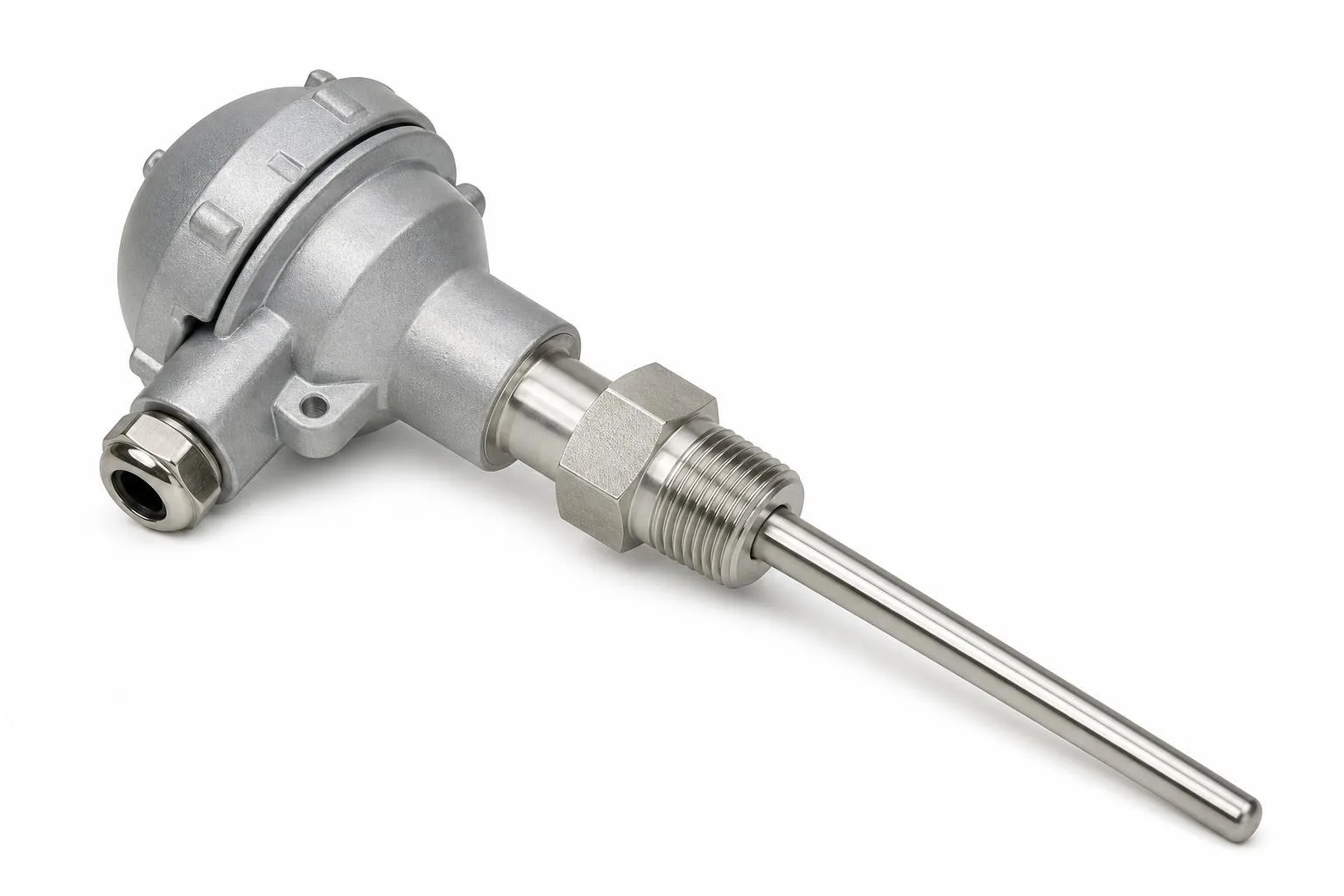
Head-Style Thermocouple Assembly
Head-style thermocouple build with a connection head, process fitting, and stainless probe/sheath geometry for installations that need protected wiring, service access, and high-temperature sensing capability.
How to specify an industrial head thermocouple
Best fit
Key build decisions
When to choose thermocouple instead of RTD
Choose a thermocouple when the process runs hotter, the probe needs to survive more severe service, response time is a priority, or the measurement point benefits from a grounded, ungrounded, or exposed junction instead of a resistance element. Choose an RTD when tighter accuracy, repeatability, and long-term stability are the primary requirements.
Terminal block or transmitter?
A terminal-block head keeps the thermocouple signal available for instrumentation that accepts thermocouple input. A head-mount transmitter converts the millivolt signal to a two-wire 4-20 mA output and is useful when the cable run is long, electrical noise is a concern, or the control system expects current-loop input.
Information that prevents quote churn
For an accurate build, provide the thermocouple type, junction style, process temperature range, sheath material and OD, immersion length, process connection, thermowell details if applicable, connection-head material, conduit entry, transmitter requirement, and any calibration or material documentation needed with the order.
Need this product configured to your application?
Share the process conditions, geometry, connection details, and documentation requirements. We can help scope the right assembly.