
Bearing Thermocouple Assemblies for Rotating Equipment
Type K and J bearing thermocouple assemblies for motors, pumps, gearboxes, and other bearing temperature monitoring points.
Product Overview
Bearing Thermocouple Assemblies with Stainless and Copper Contact Options
Bearing thermocouples are selected from the contact point and case geometry first, then the thermocouple type, single or dual construction, lead protection, and plant input.
Use the case style reference to match the bearing housing, then confirm the thermocouple type, wire size, and single or dual construction.
Case Style Reference
Start with the bearing housing and case style, then select the thermocouple type and lead construction. Dimensions are case dimensions. Wire sizes are AWG.
Decision path
- Match case style to bore, contact point, and exit clearance.
- Select Type E, J, K, or T around the existing input or plant standard.
- Use single or dual construction where the case style supports it.
- Choose stainless first, with copper contact options where needed.
- Confirm lead protection, armor, vibration, oil exposure, and routing constraints.
| Style | Case Length | Case Dia. | Single TC | Dual TC |
|---|---|---|---|---|
| A | 0.250 in.6.4 mm | 0.275 in.7.0 mm | 24 AWG | 24 AWG |
| B - Top Hat | 0.250 in.6.4 mm | 0.188 in.4.8 mm | 24 AWG | 24 AWG |
| C | 0.300 in.7.6 mm | 0.125 in.3.2 mm | 24 AWG | 24 AWG |
| D | 0.300 in.7.6 mm | 0.080 in.2.0 mm | N/A | N/A |
Bearing Thermocouple Contact and Lead Protection
Bearing thermocouples focus on localized bearing contact, protected lead routing, insertion depth, and machine-protection integration. Stainless contact styles come first, with copper contact options available where higher thermal conductivity is useful.
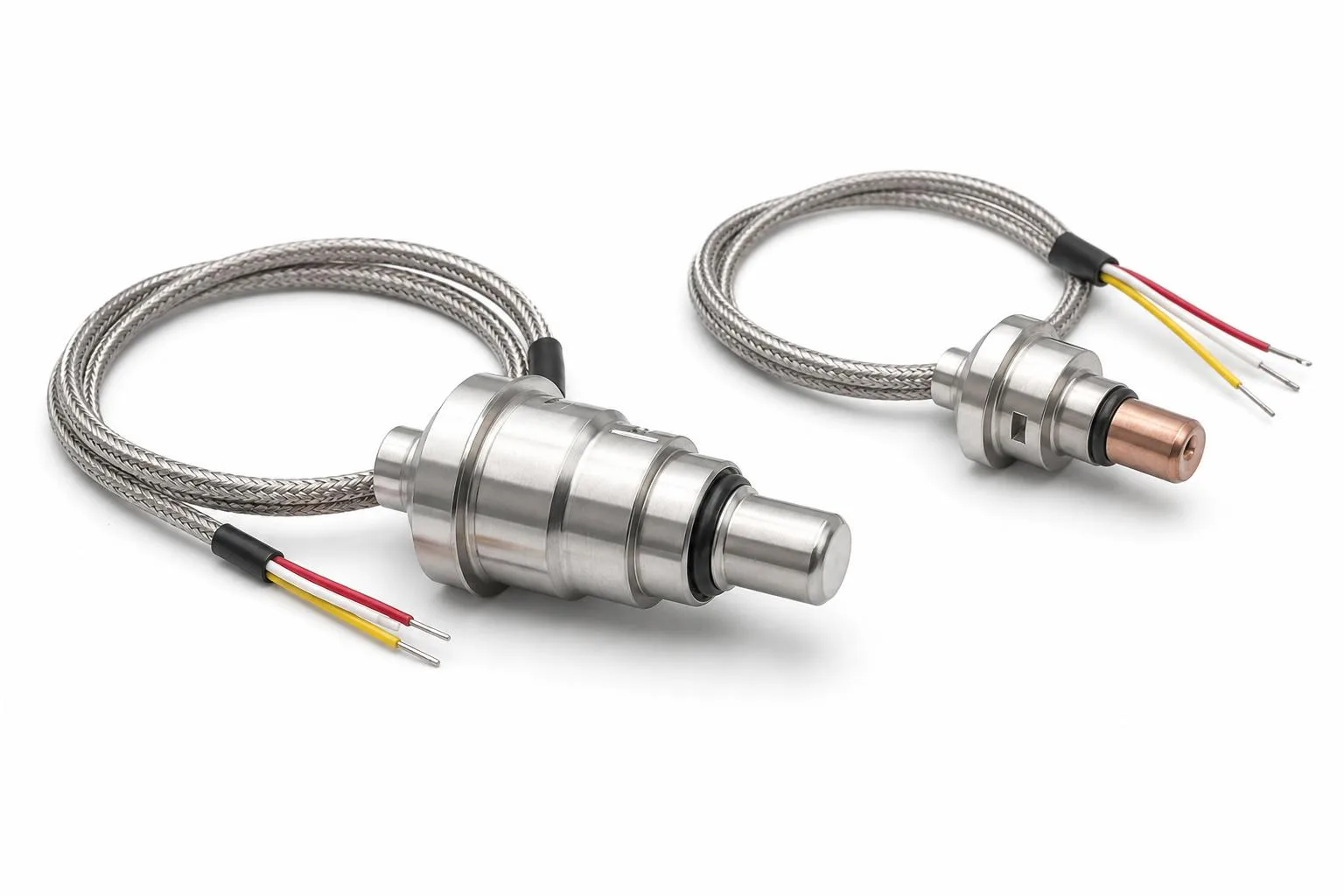
Bearing Thermocouple Contact Assembly
Use this construction when tip contact, insertion depth, lead protection, and machine reliability matter more than the specific mounting hardware.
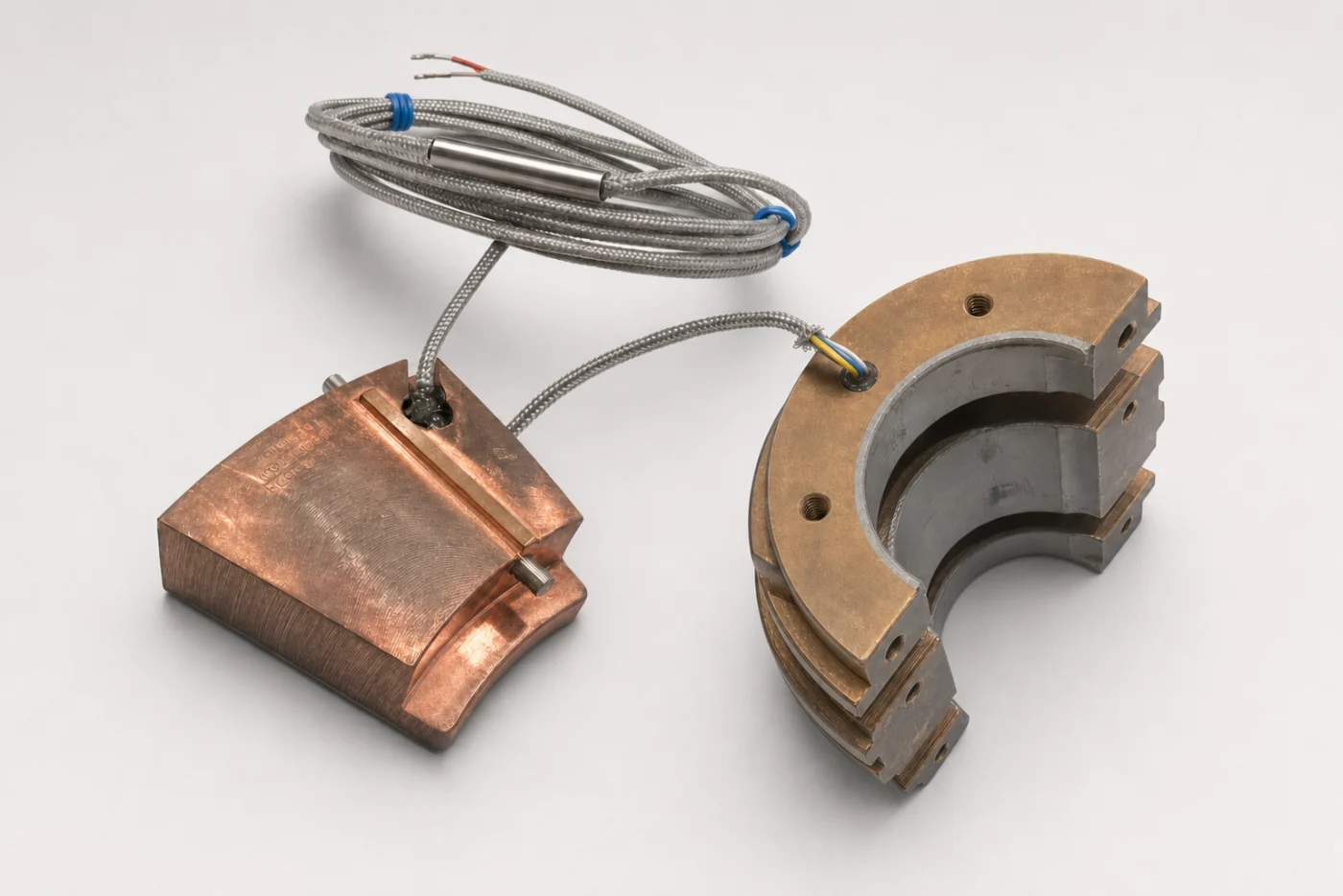
Bearing Pad and Shell Contact Builds
Use this style when the sensor needs to match a curved bearing surface, existing housing geometry, or machine-protection contact point.
Bearing Thermocouple Model Selection
Stainless Contact Bearing Thermocouple
The standard bearing thermocouple starting point is a stainless contact style for rugged bearing housing measurement, mechanical durability, and corrosion resistance around motors, turbines, turbo machinery, pumps, fans, gearboxes, and driven equipment.
For turbine and turbo machinery bearings, BTC assemblies are used when the protection loop, legacy instrumentation, or response requirement favors thermocouple input. Case geometry, contact depth, lead exit, and armor should be selected around the bearing housing so the sensor protects the machine without interfering with service access.
Copper Contact Bearing Thermocouple
Copper contact styles are available when the application benefits from higher thermal conductivity at the bearing measurement point. Copper should be positioned as the secondary option after stainless, not as the default construction.
Mounting and Retention Options
Bearing thermocouples can be configured around the housing bore, contact depth, lead protection, and retention method. Bayonet and spring-loaded hardware are useful for certain fixed-depth or repeatable-contact installations, but many bearing sensors use other contact and retention styles.
Need RTD-Based Bearing Monitoring?
For machine protection loops and applications that prefer Pt100 stability over thermocouple response, specify a BRTD Bearing RTD as the RTD counterpart.
Application Matrix
Need this product configured to your application?
Share the process conditions, geometry, connection details, and documentation requirements. We can help scope the right assembly.