
HVAC & Refrigeration
HVAC & Refrigeration Temperature Sensors
HVAC and refrigeration work values repeatability, durability, service access, and installation flexibility over exotic construction. Thermometrics supports duct, pipe, coil, chiller, refrigeration, and utility-loop measurement points with RTD and thermocouple assemblies selected for long-term stability and practical field replacement.
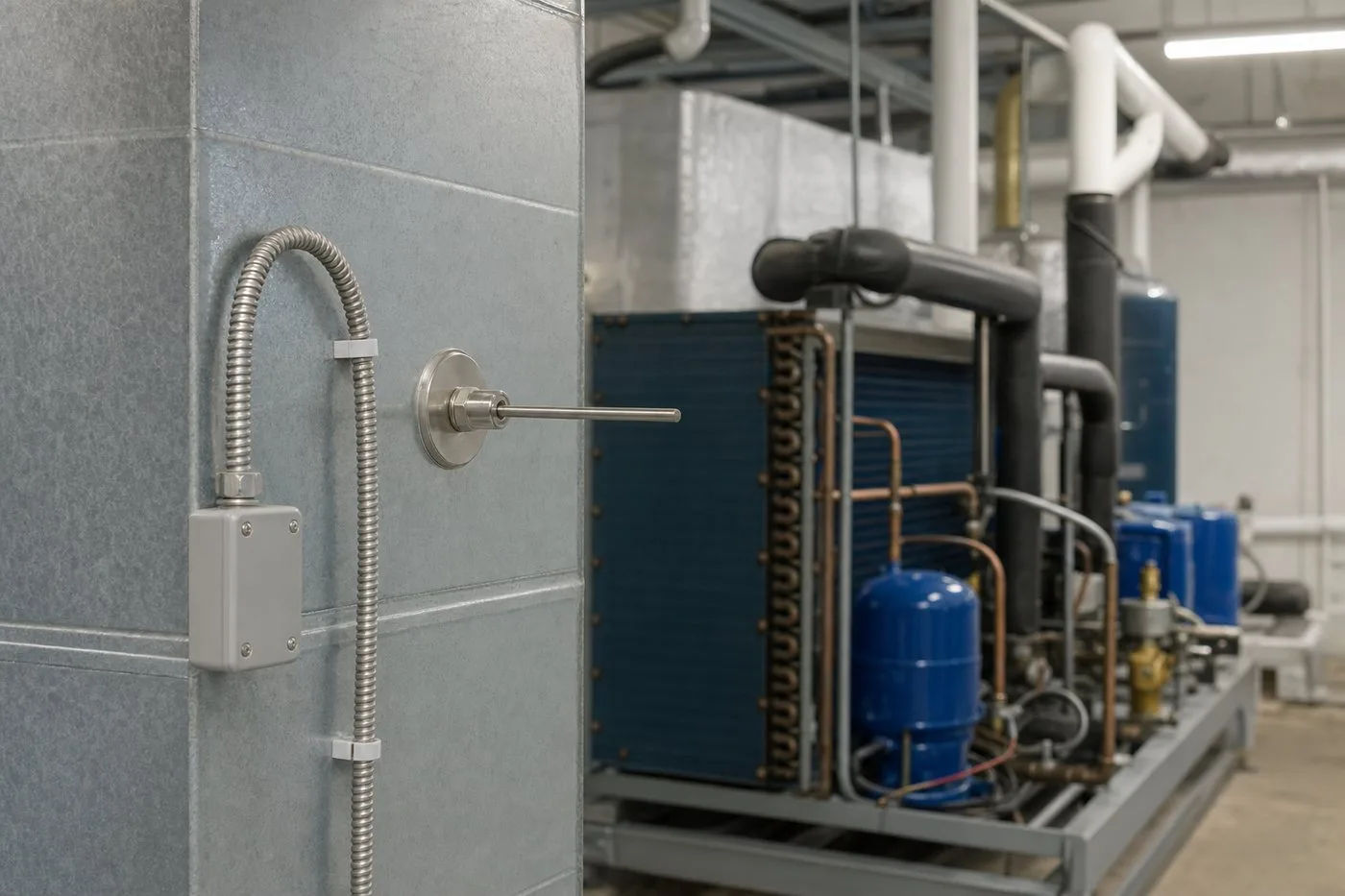
Averaging, immersion, and clamp-on sensing for coils and utility loops
Averaging sensors, clamp-on RTDs, and immersion points are used across coils, ducts, air handlers, chillers, and utility piping where zone coverage, service access, and long-term stability matter most.
Common Applications
Sensor Solutions
Averaging Sensor Specifications
| Parameter | Multi-Junction Averaging Thermocouple | Wound-Wire Averaging RTD |
|---|---|---|
| Junctions / Element | 2 to 8 junctions, series-parallel | Continuous wound platinum 100 ohm (Pt100) |
| Length | 6" to 120" | 6" to 20ft custom |
| Accuracy | ASTM E230 standard tolerance | IEC 60751 Class B, ±0.3°C at 0°C |
| Sheath | 316SS, PFA-jacketed flex, or MI cable / MIMS | Silicone flex or 316SS rigid |
| Temperature Range | Type K: −40°C to 400°C depending on sheath and insulation package | −50°C to 200°C with silicone flex |
| Wire Configuration | 2-wire junction network in parallel | 3-wire standard, 4-wire available |
| Process Connection | NPT, compression, or direct mount | NPT, flanged, or direct duct mount |
| Typical Application | Return air, furnace zone, tank bulk average | HVAC duct, air handler, dryer, mixed air |
Technology Comparison
Multi-Junction TC vs. Wound-Wire RTD
A multi-junction thermocouple averages temperature at discrete fixed points. A wound-wire RTD averages across the full sensing length continuously.
For HVAC duct averaging where spatial uniformity is unknown, the wound-wire RTD usually gives the better full-zone average. For furnaces or dryers where specific sensing points matter, a multi-junction thermocouple is often the better fit.
Both approaches are supported through the Averaging Sensors product line depending on the control architecture, routing constraints, and required accuracy.
HVAC & Building Automation Reference Points
| Measurement Point | Typical Build | Recommended Product Page |
|---|---|---|
| Supply air duct | Rigid averaging RTD, 24" to 72" | Averaging Sensors |
| Return air plenum | Flexible averaging RTD, to 10ft | Averaging Sensors |
| Chilled water coil | Averaging thermocouple, Type T cryogenic | Immersion Probes |
| Hot water coil | Rigid averaging RTD, 3-wire, transmitter-ready | Immersion Probes |
| Mixed air temperature | Multi-point averaging RTD | Averaging Sensors |
| Refrigeration suction or liquid line | External pipe sensor with clamp or strap mount | Clamp-On RTDs |
Quality & Compliance
The typical priority is dependable, repeatable field performance with build consistency, clear replacement geometry, and documentation support for commissioning, retrofit, and facility quality requirements.
Field Fit
Sensor formats that install cleanly in ducts, pipes, coils, and controls panels.
Long-Term Stability
Durable RTD and thermocouple options for building and refrigeration service.
Retrofit Flexibility
Useful for commissioning, replacement, and energy-efficiency upgrades.
Program Considerations
Recommended Sensor Products
Tell us about your application
We will recommend the right sensor, mounting method, and materials for your process and environment.