
Thermocouple Wire & Cable Sensors — Bare Wire · Duplex · Extension Cable
Thermocouple wire, cable, dual, and duplex sensor lead constructions for aerospace routing, extension runs, bare junctions, and custom harnesses.
Product Overview
Thermocouple Wire & Cable Sensors — Bare Wire · Duplex · Extension Cable
Thermocouple wire, cable, and sensor lead constructions for extension runs, bare junctions, custom harnesses, and dual or duplex aerospace instrumentation where redundant circuits or separated channels need to travel through the same routed assembly.
Wire and Cable Sensor Routing
Wire thermocouples are built around insulation, conductor type, exposed or protected junction style, and lead construction for custom routing or harness integration. Dual and duplex versions can place redundant thermocouple circuits into an aerospace or OEM harness where one routed package needs separate control, monitoring, or validation channels.
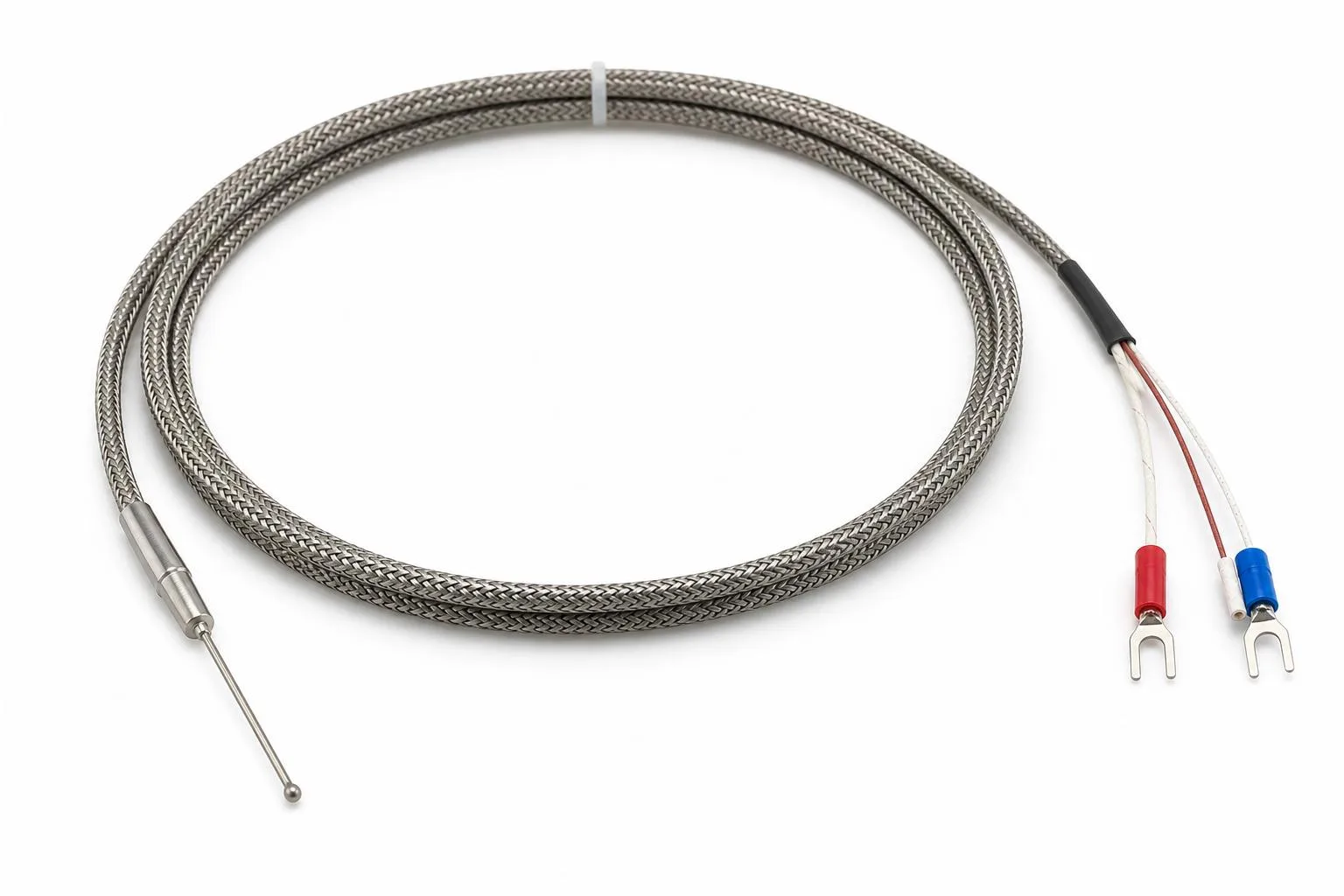
Protected Lead Construction
Use this construction when insulation, routing, abrasion resistance, and lead protection are as important as the junction location.
Thermocouple Wire Product Guide
Thermocouple Grade vs Extension Grade
Thermocouple-grade wire uses the actual thermocouple alloys (e.g., Chromel/Alumel for Type K) and is calibrated to sensing tolerances per ASTM E230. Extension-grade wire uses lower-cost alloys with the same Seebeck coefficient within a limited temperature range (typically 0°C to 200°C) and is only intended for the run from the sensor to the instrument panel. Never use extension-grade wire in the sensing zone — it introduces calibration error outside its rated range. Thermometrics supplies both grades; extension cables are color-coded to match the sensing type per ANSI MC96.1.
Insulation Selection Guide
Dual and Duplex Cable Builds
Dual and duplex wire sensors are used when one routed cable or harness needs two independent sensing circuits. Aerospace programs may use this approach for qualification fixtures, engine-adjacent test wiring, redundant validation channels, or split monitoring where routing space and documentation control matter as much as the sensing junction.
Need this product configured to your application?
Share the process conditions, geometry, connection details, and documentation requirements. We can help scope the right assembly.