
Industrial Head Temperature Sensor Assemblies
Serviceable thermocouple and RTD assemblies built with industrial connection heads, process fittings, thermowell inserts, transmitters, and wiring options for plant temperature measurement.
Product Overview
Head-style assemblies built around the measurement point
Industrial head temperature sensors are used when the measurement point needs a rugged field connection, protected terminals, and a maintainable sensor assembly. Thermometrics builds these assemblies around the application, not just the head style.
The sensing element may be a thermocouple, RTD, dual/duplex element, or mixed TC/RTD construction depending on the process temperature, accuracy requirement, response time, and installation geometry.
Common builds
A complete assembly can include the probe or insert, connection head, terminal block or transmitter, process fitting, extension, sheath material, wiring configuration, and documentation required for the job.
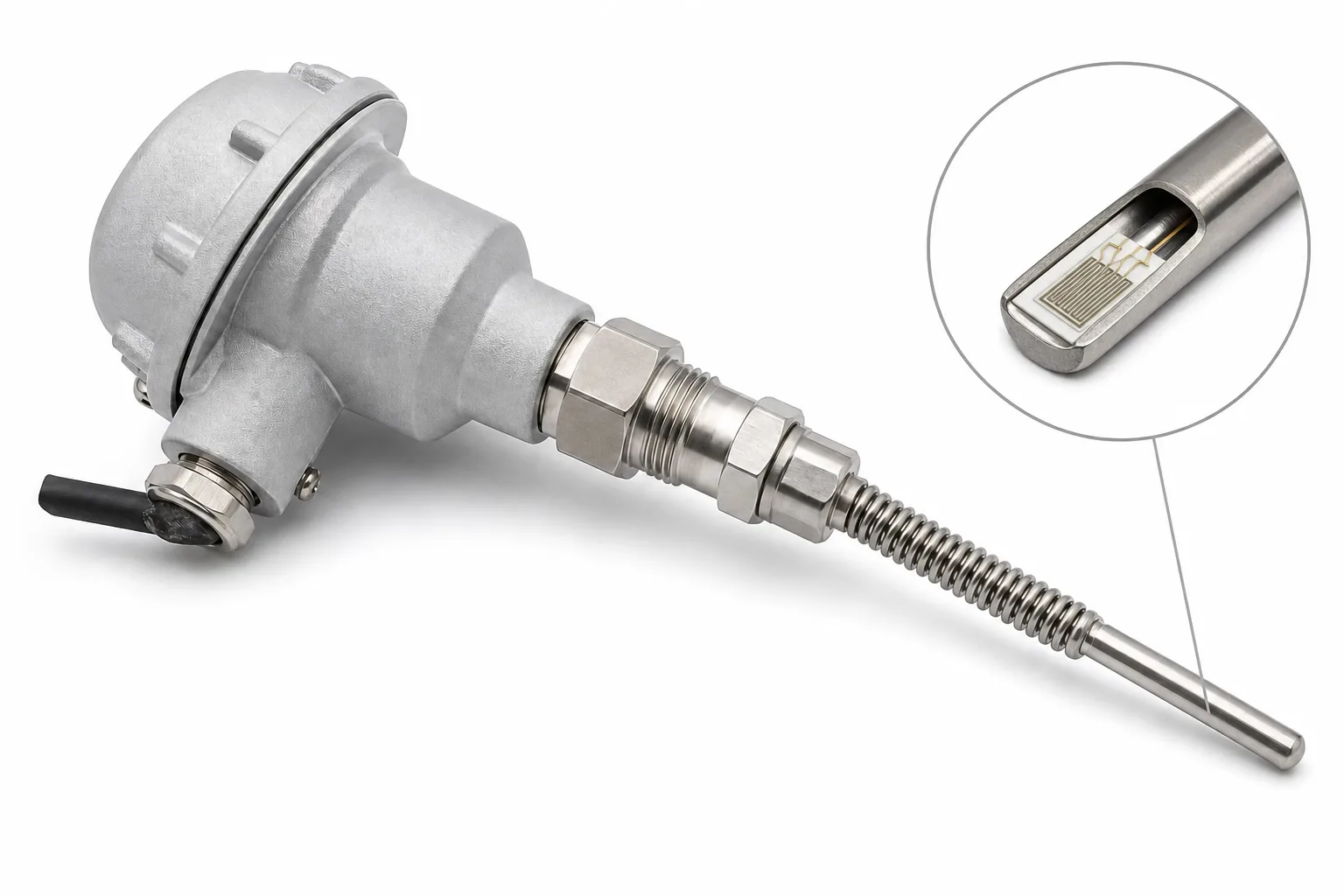
Industrial Head RTD Assemblies
Use RTD builds when accuracy, repeatability, and long-term stability are the priority. Common builds include Pt100 or Pt1000 elements, 2-, 3-, or 4-wire circuits, spring-loaded inserts, and terminal or transmitter heads for process control loops.
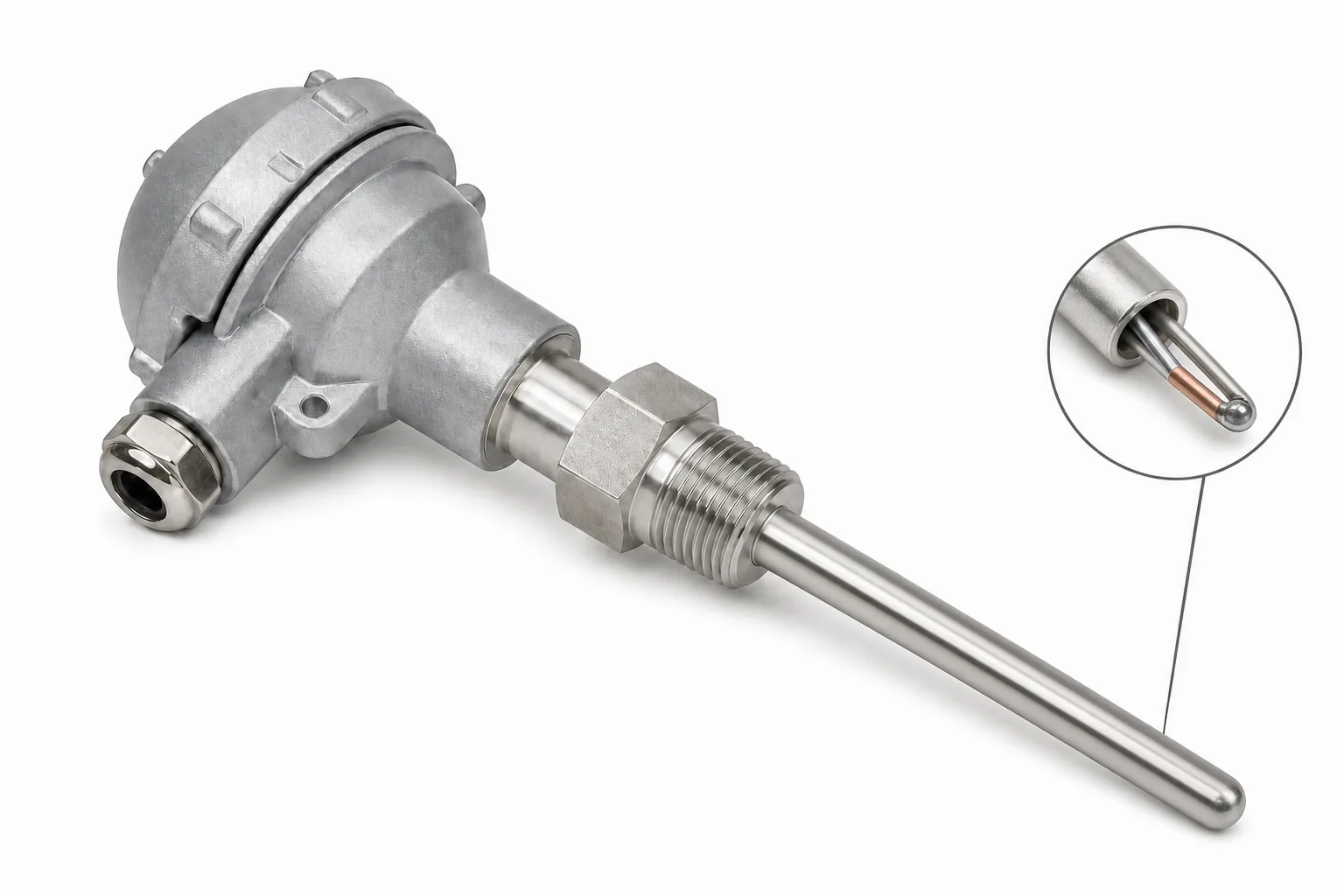
Industrial Head Thermocouple Assemblies
Use thermocouple builds when the process runs hotter, the service is more severe, or the installation needs a thermocouple junction style. Common options include Type K, J, T, E, N, R, S, and B thermocouples with grounded or ungrounded junctions.
Industrial Head Assembly Configurations
Connection head choices
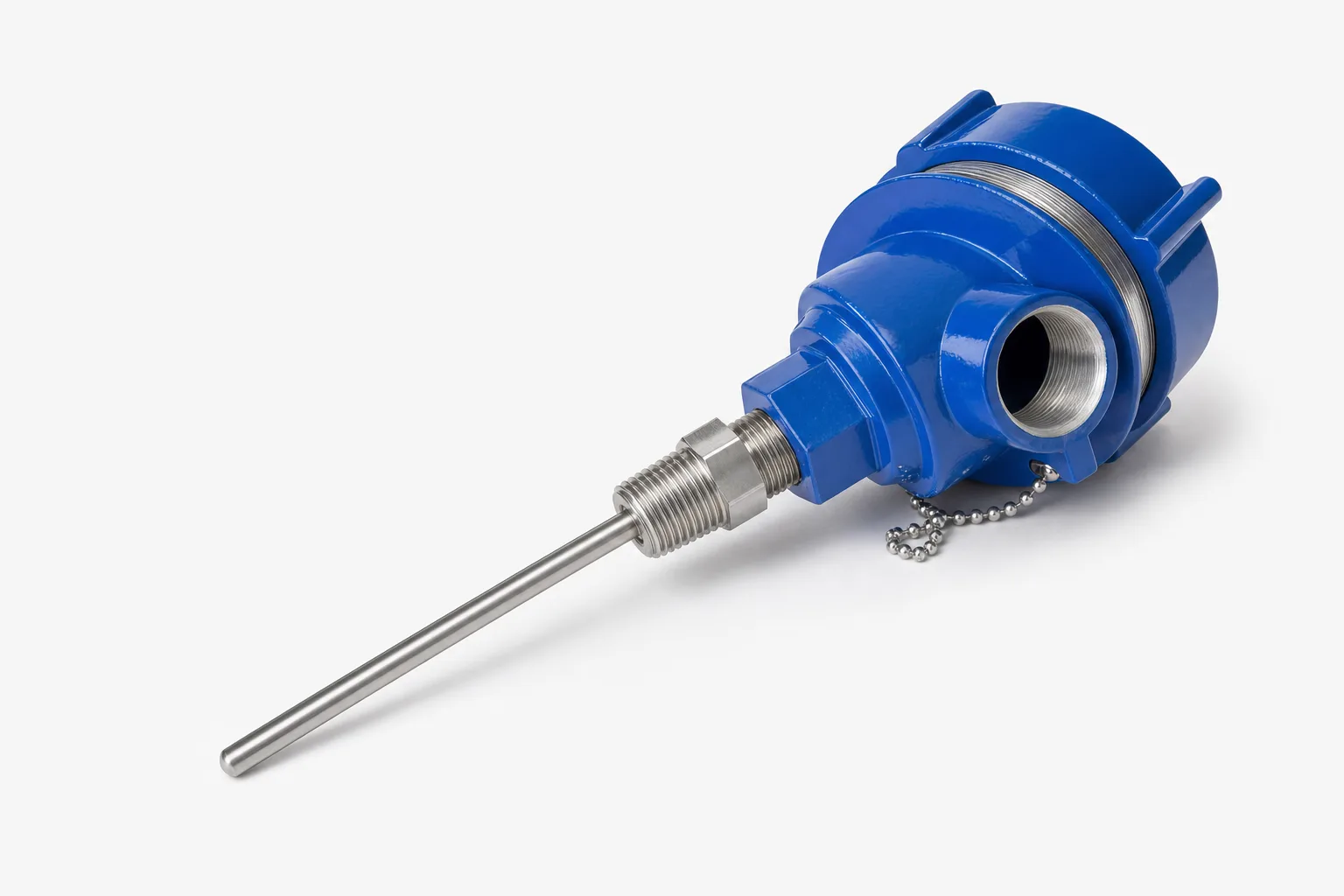
Intrinsically safe / explosion-proof direction
Explosion-proof industrial heads are available when the field enclosure, conduit entry, terminal access, or transmitter package needs to match a rated installation. For BRTD-style and other machine-protection builds, the head and wiring method should be specified with the area classification, plant documentation requirements, and instrumentation input.
Hazardous-area requirements should be discussed early so the head, conduit entry, transmitter, and wiring method are selected as part of the sensor assembly.
Selection Strategy
The main decision is not whether the part has a head. The main decision is what the measurement point needs from the sensing element, head, wiring, and installation hardware.
RTD builds
Thermocouple builds
Mixed or custom builds
Application-first quoting
If the sensor has to fit existing equipment, match a customer drawing, or serve a machine-protection point, the assembly should be scoped from the full installation instead of treated as a catalog part.
Head, Transmitter, and Wiring Options
RTD / RTD Head Assemblies
RTD head assemblies are used when accuracy, repeatability, and long-term stability drive the specification. Typical builds include Pt100 or Pt1000 elements, 2-, 3-, or 4-wire circuits, spring-loaded inserts, thermowell-mounted probes, terminal blocks, and head-mount transmitters for process control loops.
Thermocouple / Thermocouple Head Assemblies
Thermocouple head assemblies are used when the process runs hotter, the service is more severe, or the installation needs a specific thermocouple junction style. Type K, J, T, E, N, R, S, and B thermocouples can be built with grounded or ungrounded junctions, selected sheath materials, terminal blocks, or transmitter-ready heads.
Mixed TC / RTD Head Assemblies
Mixed TC/RTD assemblies are specified when one installed location needs two measurement behaviors: the thermocouple for rugged high-temperature response or system compatibility, and the RTD for stable precision measurement or comparison.
Application-Specific Head Assemblies
Some head-style builds are scoped around fit-up instead of a catalog category. Thermowell inserts, replacement probes, OEM builds, and drawing-controlled assemblies may use the same industrial head format while being designed to match an existing bore, well, fixture, or machine package.
Specification Checklist
Need this product configured to your application?
Share the process conditions, geometry, connection details, and documentation requirements. We can help scope the right assembly.